While there are still times, places and budgets that warrant an old school squawk box and inexpensive sign, most quick service restaurants (QSRs) continue down a path of tech and efficiency. Innovation is lending its hand to enhance the speed and accuracy of drive-thru operations. Today, we’ll look at four trends that are becoming more prevalent as we get further into 2026.
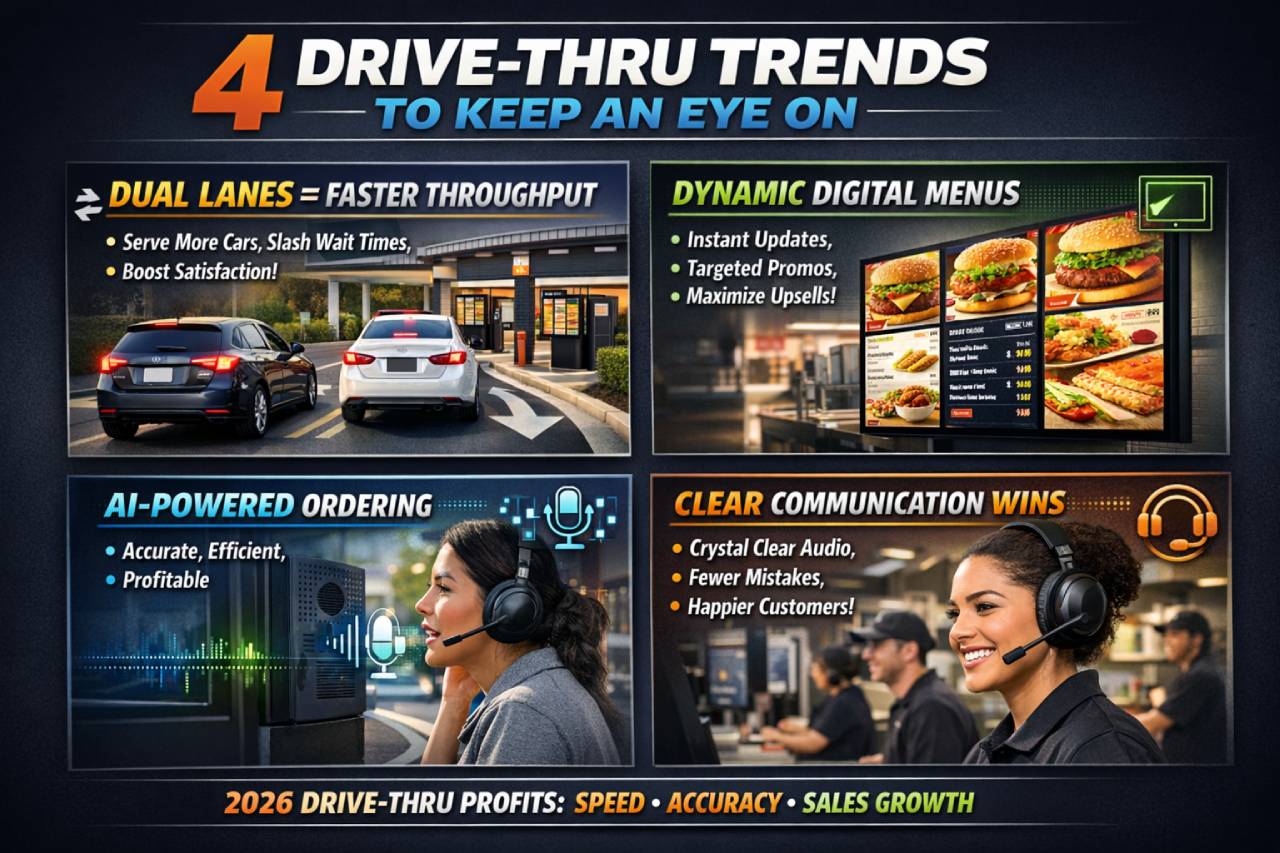
1. Dual Lane Drive-thrus
The most obvious change to many drive-thru layouts is the adoption of an additional lane. Dual lane drive-thrus combat the bottlenecks that form during peak hours that often turn away other would-be customers. In addition, when these lines form, it negatively impacts throughput. With the second lane, you can take two orders at once which speeds up the ordering process significantly. While main objective is efficiency, the harder-to-quantify customer satisfaction greatly improves as well. The reduced queue time checks the “speed of service” box. While there is an added expense up front, your ROI will be realized relatively quickly. In addition, historical data will inform you on when to close one of the lanes during slower periods. This will allow you to staff accordingly.
2. Smart Digital Drive-thrus
Traditional, backlit, static menu boards are slowly fading into obscurity. That said, they are still serviceable options for those that don’t have the budget for a digital drive-thru. You can replace graphics many times before nearing the expense of their digital counterparts. However, what you won’t get out of a static board are the dynamic capabilities of a digital drive-thru. The ability to leverage data to offer specials or discounts during slow periods, to change the highlights of your menu based on time of day or to display offerings based on inventory can all be executed with a digital board. And at its most basic form, the visuals are brighter, more crisp and simply more engaging, which leads to up-sales and increased ticket sizes.
3. Artificial Intelligence Order Taking
AI isn’t coming, it is here! While the argument can be made that there are some “kinks” to work out, there is no denying that this will become more present in our everyday ordering process as customers. Using voice recognition, AI can distinguish a customer’s orders, including their nuisances, while in various working conditions. The introduction and eventual refinement of AI order taking will reduce employee costs while increasing order accuracy. These systems can enter the orders right into the POS system, suggest add-ons based on previous orders, use license plate recognition to add a personal greeting, etc. We are at the tip of the iceberg when it comes to AI and what will become a more common drive-thru experience.
4. Cohesive Headset Systems
Clear and crisp communication from inside to outside and amongst the crew is arguably the most important drive-thru factor when it comes to both employee and customer satisfaction and order accuracy. Without it, you can have the fanciest drive-thru with all the ancillary “bells and whistles,” but if the people communicating at the drive-thru strain to hear one another it becomes frustrating and a precursor to order redos and nasty reviews. Thankfully, modern systems have noise cancelling technology and HD audio quality to cast these concerns aside. In addition, they integrate with POS systems, kitchen displays, and some ordering apps which offer a cohesive ordering process. Orders are seen in real-time which allows the food to be prepared in manner that is timed with the customer arriving to the window.
Do you need help making these determinations for your business? Give us a call today at 888-235-2579, email us at info@origindisplays.com or contact us here to speak with a solutions specialist.


